Patmos
Book of RevelationPatmos is the island setting associated with John the Apostle’s reception and recording of the Revelation. In the book’s account, confinement there becomes the earthly frame for a message directed beyond the island to the seven churches; the author later imagines Patmos as the difficult setting in which John turned that revelation into a written text.
Setting and Confinement
The text identifies John as being on the island of Patmos because of the word of God and the testimony of Jesus Christ. It does not provide a detailed description of the island. Its importance comes instead from the circumstances attached to John’s presence there: he is in confinement, yet receives a revelation intended for a wider community.
The author connects this setting with the opening vision. On the Lord’s Day, John is in the Spirit and hears a voice behind him. Turning toward it, he sees Jesus Christ among seven golden lampstands. The island thus marks the setting of an encounter that is immediately oriented outward: John is instructed to write what he sees and send it to seven churches.
The Island and the Act of Writing
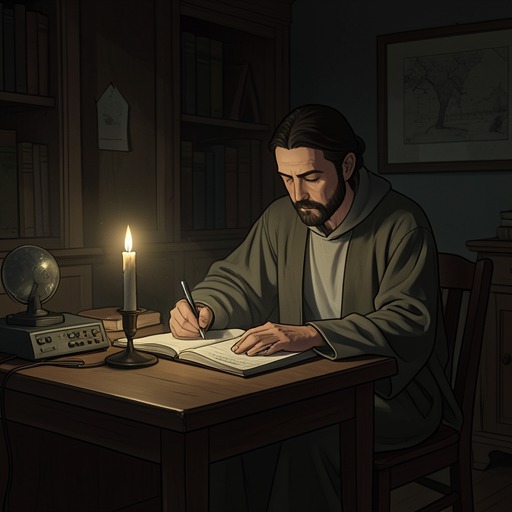
The book’s account of John’s confinement is later expanded into an imagined scene of composition. The author supposes that John returned from the vision to the realities of imprisonment on Patmos and understood that he had to write down what had been revealed. The author further imagines that John may have been living in a shelter rather than a jail cell, without parchment or pen readily available.
In this reconstruction, friends smuggle writing materials in to John and later carry his writings out. These practical details are presented as the author’s imagining, not as facts established by the text. They make Patmos more than the setting of a vision: in the author’s account, it is also the constrained place where a private revelation becomes a message that can circulate among the churches.
Patmos and the Book’s Sequence
The author’s account of writing on Patmos also supports his distinction between the order in which John received material and the chronological order of the end-time events described. He proposes that John was already well into what is now chapter 10 when an angel interrupted him with additional revelation. John inserted that material where it arrived, rather than rearranging the whole account to make its presentation follow event chronology.
The author describes a second interruption at Revelation 17:1. In his reconstruction, John adds that further revelation and then resumes the writing he had set aside. Patmos therefore anchors the author’s explanation of how a single written book could contain material that, in his reading, must be moved to understand the events in chronological order. The proposed writing process is an interpretive reconstruction, while the broader point is that the author treats the book’s present sequence as distinct from the sequence of the events it depicts.
Narrative Significance
Patmos links witness, revelation, and transmission. John’s confinement supplies the setting for receiving the message; the command to write makes that experience communicable; and the author’s imagined arrival of parchment and pen supplies a practical bridge between vision and text. The island is not developed as a richly described landscape, but its narrative function is clear: revelation occurs there, and from there the message is directed toward readers beyond John’s immediate circumstances.